Project Overview
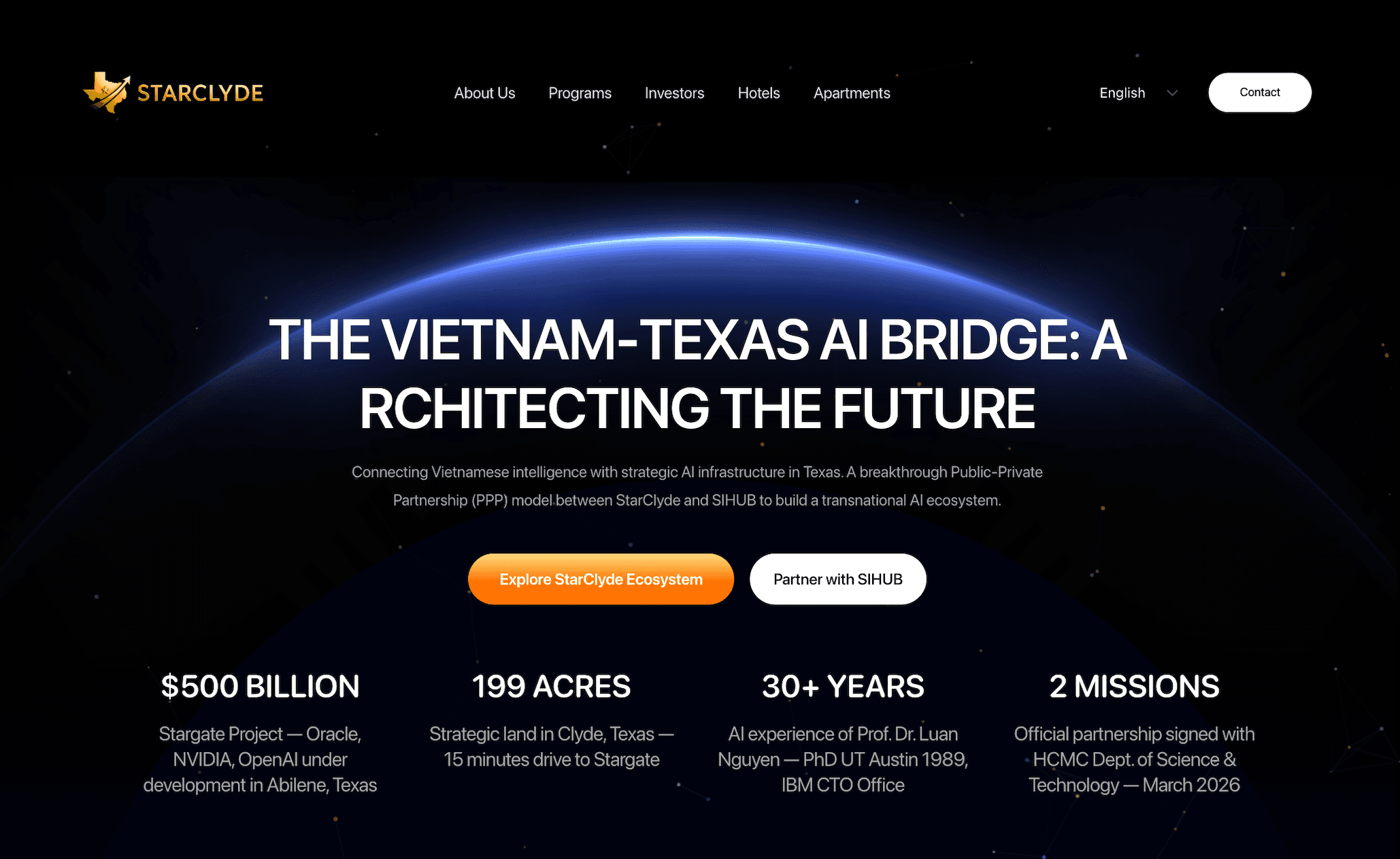
StarClyde AI Gateway District is a strategic physical AI bridge connecting Vietnam with Texas, situated on a 199-acre parcel (~805,000 m²) in Clyde, Texas — just 15 minutes away from the $500B Stargate mega-project by Oracle, NVIDIA, and OpenAI in Abilene.
The project operates under an official Public-Private Partnership (PPP) framework established with the Department of Science & Technology of Ho Chi Minh City and SIHUB (Saigon Innovation Hub). Its mission is to create a physical and intellectual conduit for Vietnamese engineers, startups, and institutions to directly interface with the epicentre of global AI infrastructure.
To communicate this ambitious vision to venture capital firms, enterprise partners (such as Oracle, SoftBank, and NVIDIA), and high-level government delegations, StarClyde required an enterprise-grade digital portal: elegant, secure, bilingual, and engineered for peak visual performance.
Problem Statement
Business Problem
- Establishing Global Credibility: Partnering with world-class tech giants and municipal governments requires a digital presence that reflects institutional authority, precision, and modern technological craft.
- Synthesizing Complex Multi-tier Systems: The project spans multiple interrelated domains: 50MW Data Centers, 40MW Solar Infrastructure, a 3-Stage Incubator program modeled after the Austin Technology Incubator, and Apart-hotel / Hospitality facilities.
- Cross-Border Reach: The platform needed to engage two primary audiences simultaneously: Vietnamese policymakers and engineers (Vietnamese) alongside Silicon Valley and Texas venture capitalists and operators (English).
User Problem
- High-level decision makers (investors, municipal delegates, founders) need to grasp strategic value propositions and geographical proximity within 60 seconds of landing.
- The interface must remain fluid and responsive across desktop monitors and mobile devices without stutter from heavy graphical shaders.
Project Goals
- Architect a High-End Dark Mode web platform blending canvas particle systems with refined typographic hierarchy.
- Achieve a 95+ Google Lighthouse performance rating despite rich visual animations and ambient video backdrops.
- Deliver seamless Bilingual Internationalization (i18n) with edge-based locale resolution and zero cumulative layout shift.
- Integrate comprehensive Schema.org JSON-LD structured data for enhanced discoverability across search engines and social platforms.
Team & Scope
My Responsibilities & Ownership
- Frontend Architecture: End-to-end setup on Next.js 16 App Router, Tailwind CSS design tokens, and modular UI structure.
- Interactive Motion Engineering: Developed the custom Horizon glow, particle canvas animation, interactive roadmap timeline, and strategic pillars bento interactions.
- Internationalization (i18n): Implemented dynamic locale routing and seamless bilingual dictionary integration.
- Performance & SEO: Asset preloading, sub-resource integrity, font subsetting, and full Schema JSON-LD graphs.
Technical Architecture
- Core Framework: Next.js 16 App Router with Turbopack.
- Routing & i18n:
next-intlDynamic route segments. - Styling: Tailwind CSS with fluid typography tokens and dark mode palette.
- Graphics & Motion: Lightweight 2D Canvas API + CSS hardware-accelerated animations.